Posted by Max Hobbs on 25 June 2025
On 22 May 2025, the District Court of Luxembourg issued judgment against the Luxembourg bank Edmond de Rothschild (Europe) SA (Edmond de Rothschild). The Court confiscated €25m of Edmond de Rothschild’s assets for money laundering offences and receiving stolen goods.
This followed a settlement agreement, approved by the Luxembourg Court on 2 April 2025, between the Luxembourg Prosecutor General’s Office and Edmond de Rothschild, in which Edmond de Rothschild pleaded guilty to the offences.
The settlement and related conviction all relate to the “1MDB” fraud, which is one of the largest cases of fraud and money laundering in history. Approximately $4.5bn was misappropriated from what was supposed to be an investment fund to benefit the people of Malaysia.
The specific wrongdoing in question related to Edmond de Rothschild reportedly receiving nearly half a billion dollars from a United Arab Emirates (UAE) national. This individual, a client of the bank, is alleged to have participated in the 1MDB fraud and had opened “dozens” of accounts in the names of multiple offshore entities. Luxembourg investigators managed to establish the origin of the funds, ultimately tracing them back – via multiple jurisdictions and transactions – to the 1MDB fund.
This judgment concludes only one part of the investigation, which started in 2016. The Luxembourg Court is clear that: (i) this judgment closes the question of the bank’s criminal liability, which was settled when it entered into the agreement in April; (ii) there is a second stage, focused on individuals at the bank, in which the investigation is closed and the matter now lies with the public prosecutor; and (iii) the investigation into the bank’s client and his companies remains open and is “actively continuing”.
On many levels, this settlement agreement and conviction are significant. As the Court clearly stated, this is the first time that a Luxembourg banking institution has been convicted of money laundering.[1] It also represents a notable step in efforts to recover funds and seek justice for the vast 1MDB fraud.
1MDB fraud – the response
There have been a series of convictions and recovery orders worldwide since the 1MDB scandal came to light. In many ways it is a remarkable story of an international and institutional response to corruption. As of early 2025, the Malaysian Anti-Corruption Commission said that near 30 million Malaysian Ringgit had been recovered, thought to be about 70% of the total amount embezzled.
The global enforcement effort includes one of the largest enforcement actions of all time under the US Foreign Corrupt Practices Act, in 2020, when Goldman Sachs entered a deferred prosecution agreement with the US Department of Justice (DOJ), under which it agreed to pay a fine of more than $2.9bn as part of a coordinated resolution with authorities in the US, UK, Singapore and elsewhere.
Then, on 29 May 2025, only a week after the Luxembourg Court published its judgment against Edmond de Rothschild, a former Goldman Sachs banker (Tim Leissner) was sentenced to two years’ imprisonment, having pleaded guilty in the US to bribery and money laundering offences for his part in the 1MDB scheme.
Enforcement has not been restricted to the US. For example, among many others worldwide, the Swiss authorities have secured a range of convictions against individuals at multiple different firms and has conducted investigations and issued fines against multiple banks for their part in the scandal. Malaysia has also directly secured convictions and made recovery of funds, including the conviction of the former Prime Minister. These efforts continue. At the end of 2024, the 1MDB fund filed a $1bn claim in the British Virgin Islands against a Hong Kong-based corporate services provider.
The consequences of the 1MDB scandal are not just limited to enforcement and recovery action. A potentially greater consequence has been a similarly global push to improve anti-financial crime compliance, detection and prevention systems throughout the banking and finance world. Many commentators, Governments and regulators consider that the 1MDB scandal was largely facilitated by – and was perhaps the apotheosis of – weaknesses and deficiencies in AML and financial crime controls in the global financial system. The response has included a number of legislative and regulatory measures to help prevent a similar scandal from happening again.
This case illustrates that there may still be some way to go for financial institutions around the world to effectively manage financial crime. However, it also indicates that there is a growing appetite around the world to take action where deficiencies are found, including in what have historically been considered very pro-banking jurisdictions such as Switzerland and Luxembourg.
In terms of what may come next, the three parts of the case articulated in the Luxembourg Court’s announcement (set out above) make this clear. It is also illustrated by the US proceedings against Goldman Sachs, in which a settlement agreement (and large fine) with a financial institution has now been followed by a conviction of an individual. It appears the Luxembourg authorities wish to follow the same trajectory with their investigation and will move to a second stage where they seek to secure convictions of the relevant individuals at Edmond de Rotschild. This may then be followed by further investigation or proceedings against the underlying client and his companies.
Co-operation and remediation
The Luxembourg Court’s judgment, and the settlement agreement that preceded it, are not publicly available at the time of writing. We therefore do not have full details of the wrongdoing in question or an explanation as to how the fine was determined.
However, on 22 May 2025 Edmond de Rothschild issued its own statement in response to the judgment. This was very short and made clear the bank had put the matter behind it. It describes how this “stems from events that occurred around fifteen years ago” and that “these historical events” led to a comprehensive remediation plan in the bank, launched in 2016 and completed in 2019. It also states that the relevant employees are “no longer part” of the organisation.
It concludes by saying “The Bank fully and transparently cooperated with the authorities throughout the proceedings and welcomes the opportunity to definitively close this chapter”.
There are a few notable points here. In particular, Edmond de Rothschild describes how it “transparently cooperated” with the authorities. This is very much a global trend in terms of enforcement. The DOJ in the US, the Serious Fraud Office (SFO) in the UK and the Parquet national financier (PNF) in France have all published official guidance that encourages corporate self-reporting and co-operation as a way of securing non-prosecution deals. While this is not an approach universally adopted in all jurisdictions, it is increasingly the norm. As non-prosecution resolution schemes become more common around the world, so too are the expectations that firms will report, cooperate and remediate any issues that arise, at their own expense.
Exactly what constitutes cooperation can vary in each jurisdiction and is not always clear, despite the published guidance on the subject. However, the fact that Edmond de Rothschild implemented a remediation programme over three years indicates that it responded quickly and substantively. It has been reported that Edmond de Rothschild received nearly US$500m from the individual implicated in the 1MDB scheme. For the Luxembourg Court to only order confiscation €25m as punishment suggests that the bank was able to significantly mitigate its wrongdoing and reduce its potential penalty by virtue of its cooperation. This reflects the trend of recent enforcement action in the UK and other jurisdictions.
This case is also a good example of how firms need to be constantly alert to the changing nature of financial crime risk and the developing risk environment. For example, in this case the bank’s wrongdoing stemmed from how it handled a client from the UAE, which was a jurisdiction heavily implicated in the 1MDB scandal. Given how prominent the 1MDB scandal was at the time, it may have been appropriate to treat UAE clients – especially those with connections to Malaysia – as higher risk. Even now, firms might reasonably factor that into their risk assessments and onboarding processes.
However, on 10 June 2025 (shortly after this conviction) the European Commission (EC) updated its list of high-risk jurisdictions for AML and CFT, reflecting updates by the Financial Action Task Force (FATF).[2] This was a fairly major overhaul of the EC’s list, with ten countries being added and nine removed from it. Included in the nine countries removed from the EC’s list was the United Arab Emirates (UAE).
Here, then, is an interesting example of how institutions must be careful when understanding the implications of this matter. On the one hand, the offending in question related to an individual from the UAE. On the other, less than a month after the judgment was published the UAE’s AML risk profile was formally downgraded by the EC. It could be hard to reconcile those two.
Ultimately, a firm’s risk assessment (and the policies and procedures stemming from it) needs to reflect the specific risks to which that firm is exposed and the firm’s attitude to that risk. A firm’s processes should not be “off the shelf”. Just as Edmond de Rothschild seems to have been caught out by a failure to respond to the developing 1MDB scandal, so too should firms ensure – as far as possible – that they review, update and adapt their anti-financial crime arrangements to reflect the specific risks to which they are exposed. How they respond to this judgment and the updated FATF and EC lists will be a matter for careful consideration.
Conclusions
The conviction of Edmond de Rothschild contains a few key lessons for financial institutions and anti-financial crime professionals:
There appears to be a growing trend of international cooperation between national enforcement agencies. This was illustrated by the recent announcement of a new Anti-Corruption Taskforce between the French, British and Swiss authorities. In that vein, it is notable that this case involved mutual legal assistance requests from the Luxembourg authorities sent to nine countries, including the UK, US, UAE, British Virgin Islands, three European countries and others. As financial crime becomes more international, so too is the response.
This conviction is undoubtedly significant. It is the first conviction of a Luxembourg bank and yet another step towards seeking justice for the 1MDB fraud. However, given the recent trend towards greater international co-operation, this conviction should perhaps be seen as symptomatic of a new, global enforcement environment rather than an outlier or exceptional event. Firms would be well advised to take note.
If you have any questions on your own organisation’s money laundering compliance, please get in touch.
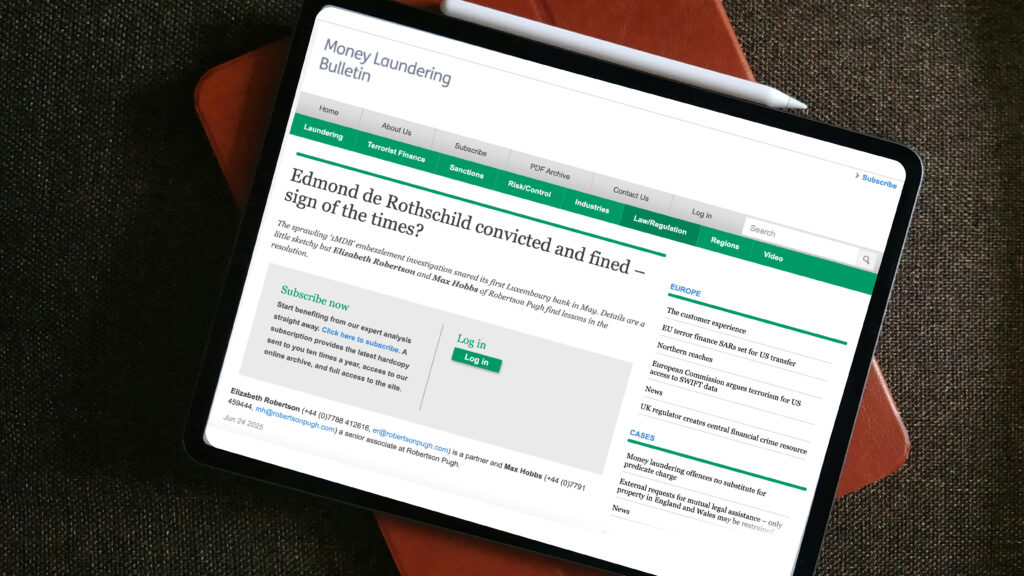
This article first appeared on www.moneylaunderingbulletin.com
[1] https://justice.public.lu/fr/actualites/2025/05/jugement-tal-7e-chambre-1mdb-rothschild.html
[2] https://finance.ec.europa.eu/news/commission-updates-list-high-risk-countries-strengthen-international-fight-against-financial-crime-2025-06-10_en